Global oil demand is forecast to grow by 1.29% or 1.2m barrels per day to 94.18m barrels per day in 2016. However, due to sluggish economic activity in a number of regions growth figures are significantly below the forecasts. For example, global oil consumption increased by 1.54m barrels per day in 2015. The more-than-expected slowdown in the Chinese economy and weak recovery rates in the EU, Russia and other countries will have a negative impact on the growth forecasts. This may exert additional pressure on the price and mood of oil traders, especially speculators.
Officially, global supply will practically not change from the 2015 levels and is estimated at 95.2m barrels per day. The stagnation of production is blamed, above all, on further cuts in the capital-intensive output of shale oil and oil from tar sands in the US and Canada. Even then the global market will continue to have excess oil supply to the tune of 1m barrels per day (about 49m tonnes a year), although the figure stood at 2.1m barrels per day (over 102m tonnes a year) in 2015. Substantial upward corrections in this forecast will be made by further expansion in production in Iran, Iraq and other Opec countries, given the cartel’s inability to agree conditions on the “freeze” of production, as well as geopolitical tension between Riyadh and Tehran. For instance, on June 2, as was expected, Opec members failed to agree on capping production, while the global market will, judging by all appearance, have to wait for the next meeting of the organisation scheduled for 30 November 2016. As a result, we don’t rule out another excess supplies of oil (over 2m barrels per day) on the global market, which will be capable of provoking another collapse in the price. In addition, we should bear in mind steady increase in commercial reserves in developed economies of the OECD.
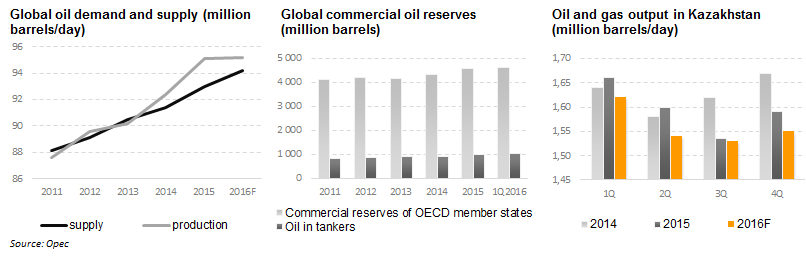
According to Opec’s estimates, Kazakh oil and gas condensate output will decrease by 40,000 barrels per day to 1.56m barrels per day or to 76m tonnes in 2016. These estimates are based on the fact that the Kashagan field would relaunch production only in June 2017, not in November 2016 (the Kazakh government still insists on this timeframe). Along with Kazakhstan, the steepest decrease in output in 2016 is expected in the US, China, Mexico, the UK, Azerbaijan, Yemen and Colombia. However, there may well be manifestations of force majeure factors (the escalation of internal conflicts, subversions against oil facilities and infrastructure, industry actions and so on) which may affect oil productions in Nigeria, Iraq, Libya and some other countries.