The free-floating tenge has forced shoppers to return to the domestic market and increased retailers’ revenue. The combined revenue of large, medium-sized and small retailers stood at KZT3.1tn in January-March 2016, a 39% increase year on year.
Between the end of 2014 and June 2015 the national retail market had been under pressure from a strong tenge compared to the currencies of neighbouring countries which resulted in consumer demand shifting towards cheaper Russian goods. This badly affected small retailers whose quarterly sales fell to a record low of KZT842bn at the beginning of 2015. Sales by large and medium-sized retailers stood at KZT1.4tn in the first quarter of 2015.
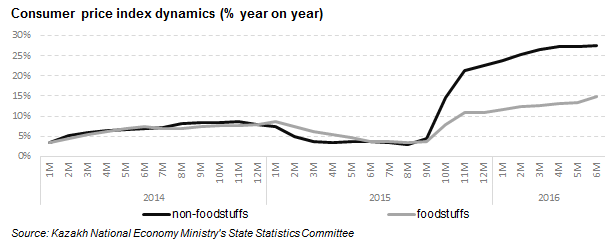
The situation has markedly improved this year. Small trading enterprises posted a sharp growth in sales which stood at almost KZT2tn in the first three months of 2016. Sales by large and medium-sized retailers did not change year on year at KZT1.3tn in the given period.
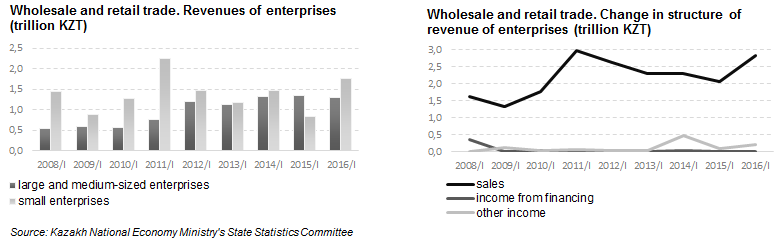
The combined quarterly sales had been falling during four years from a peak of KZT2.6tn in January-March 2011 to a minimum of KZT2.1tn in the first quarter of 2015. Trading enterprises increased sales to KZT2.8tn in January-March 2016.
The bulk of growth in sales came from small enterprises – by KZT824bn compared to the first quarter of 2015, while large and medium-sized retailers reduced sales by KZT87bn.
Non-core revenue (from financing and other activities) did practically impact sales as their share did not exceed 7%. However, non-core revenue almost doubled from KZT120bn to KZT245bn in the past year.
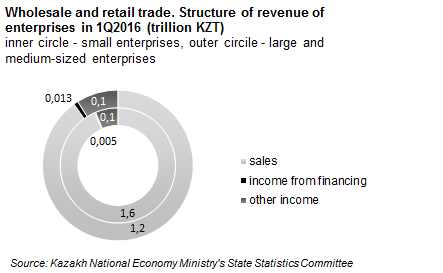
Reduction in sales, be it small, large retailers are trying to compensate for by income from financing, financial assistance from owners and other non-core activities. The share of such income increased from 7% to 10% of total sales - to KZT129bn from KZT93bn in the past year.
Small enterprises, although having increased non-core income by 330% from KZT23bn to KZT116bn, but their share in total revenue stood at only 7%.
At the same time, growth in revenue, supported by the depreciation of the tenge, was also accompanied by growth in spending by the retail market. At revenue at KZT3.1tn in January-March 2016 their spending totalled KZT3tn. Spending by large, medium-sized and small enterprises increased by 39% in the past year.
Spending by small trading increased particularly sharply: it more than doubled in the past year from KZT813bn to KZT1.7tn. Spending by large and medium-sized retailed fell by 4% year on year to KZT1.3tn in January-March 2016.
As a result, the profit margin of small retailers was only 3% in the first quarter of 2016 against 4% in January-March 2015. The profit margin of large and medium-sized enterprises increased to 2% from 1% in the past year.
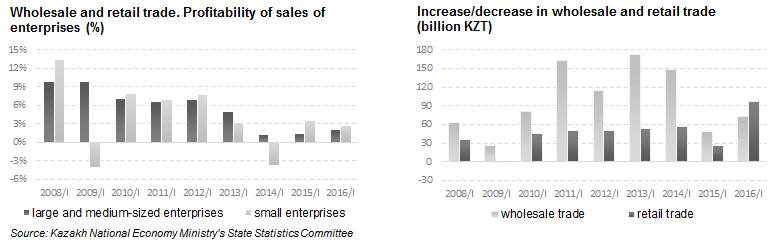
Growth in revenue in trade mainly came from a boost in retail trade. Growth in both retail and wholesale trade fell to a five-year minimum in January-March 2015, whereas domestic trade recovered in 2016.
Wholesale trade increased by 6% or by KZT73bn year on year to KZT1.2tn in the first quarter of 2015. Retailing showed even sharper growth – by 21% or KZT97bn year on year in the given period. The total volume of retail trade was estimated at KZT550bn in Kazakhstan in the first quarter of 2016.